

Does foreign ownership automatically mean your Dutch operation must prepare local statutory accounts under Dutch GAAP? Not necessarily. Dutch GAAP for foreign companies depends on the structure of the Dutch operation and the purpose of its reporting, so a subsidiary and a branch shouldn’t be treated as interchangeable. This distinction can be difficult to assess, especially when the parent company also needs figures prepared under IFRS or another group reporting framework.
This guide explains how to assess whether local statutory reporting may apply, coordinate Dutch accounts with group reporting, and organise a clear compliance process. You’ll learn which factors to consider for Dutch entities and branches, why local and group reporting may require separate treatments, and how consistent bookkeeping supports annual-account preparation and tax compliance. By assigning reporting responsibilities and planning how records will be used, you can make Dutch reporting a routine part of your international finance process rather than a last-minute task.
Key Takeaways
- Dutch GAAP for foreign companies depends on the Dutch operation’s structure and reporting purpose, not foreign ownership alone.
- Separate local statutory accounts from parent-company reporting packages to identify where requirements and reporting needs differ.
- Map the process from transaction records to financial statements and any applicable filing, with clear responsibility at each stage.
- Plan reconciliations between Dutch records and group reporting early to reduce avoidable cross-border reporting friction.
- Connect ongoing bookkeeping, tax compliance and annual-account preparation to build a more consistent local reporting process.
Dutch GAAP for foreign companies: when does local reporting apply?
Dutch GAAP is the framework of accounting rules used to prepare financial statements where Dutch statutory reporting requirements apply. Its legal foundation includes Title 9 of Book 2 of the Dutch Civil Code, supported by guidance from the Dutch Accounting Standards Board. For a foreign-owned operation, the starting point is not the owner’s nationality. It’s the Dutch operation’s legal structure, statutory responsibilities and the purpose of its accounts.
This distinction matters because Dutch statutory accounts serve a different purpose from internal management reports or packages prepared for a parent company. A general introduction to Generally Accepted Accounting Principles (GAAP) explains the broader concept; the applicable Dutch rules and guidance determine how local statutory accounts are prepared.
What does Dutch GAAP mean in practice?
Statutory financial statements are formal accounts prepared to meet applicable legal reporting duties. They present an entity’s financial position and performance according to the requirements that apply to it. Management reports, forecasts and group reporting packages, by contrast, support internal decisions or parent-company consolidation. They may use the same bookkeeping records, but they don’t automatically replace statutory accounts.
The applicable presentation, measurement and disclosure requirements depend on the reporting entity and its circumstances. A parent company may use IFRS or another group framework, while a Dutch entity’s statutory accounts follow Dutch requirements. The two outputs can share source data without being identical.
Which foreign-company structures need closer assessment?
A Dutch subsidiary, such as a locally established company, is a separate legal entity from its foreign parent. Its legal form and reporting position therefore need to be assessed when deciding whether Dutch statutory accounts are required. A foreign company operating through a Dutch branch has a different structure: the branch is generally part of the foreign legal entity rather than a separate Dutch company. That distinction affects the reporting analysis, but doesn’t by itself settle every local obligation.
Registration information is a useful starting point, not a complete conclusion. Review the entity’s legal form, Dutch registrations, existing accounts and intended use of its financial information. Then establish which duties apply to that structure, including whether accounts must be prepared or filed locally. Don’t assume that every foreign company with Dutch activity has the same obligations, or that a branch and subsidiary follow an identical process.
- Identify the reporting entity: Is the Dutch operation a separate legal entity or part of a foreign company?
- Separate reporting purposes: Are the accounts for statutory compliance, management decisions or group consolidation?
- Assess the applicable rules: Consider the entity’s legal form and duties against current Dutch reporting requirements before setting the accounting process.
This structure-first assessment gives finance teams a sound basis for coordinating local bookkeeping and parent reporting. It also helps prevent group instructions from being mistaken for a complete answer to Dutch statutory responsibilities.
How Dutch GAAP connects to Dutch statutory accounts and annual reporting
Once you understand the reporting position, the next task is to build a dependable route from day-to-day bookkeeping to year-end accounts. For Dutch GAAP for foreign companies, accounting records are the starting point, not the finished report. They need to be complete, traceable and organised so the applicable reporting framework can be applied to the right entity.
From accounting records to annual accounts
Each stage supports the next. Record transactions using consistent account codes and retain source documents such as invoices, bank records and agreements. At period end, reconcile balances to supporting evidence, investigate differences and review relevant estimates. This makes it easier to explain the figures used to prepare financial statements and trace them back to the underlying records.
The reporting framework informs how information is presented and what disclosures are needed. Requirements can differ according to the entity and its circumstances, so a group template shouldn’t replace an assessment of Dutch rules. For example, a group reporting package may organise costs by internal business unit, while statutory accounts must present information according to the requirements that apply to the Dutch reporting entity. The underlying transaction data may be shared, but adjustments or additional disclosures may be needed.
A practical year-end file can bring together reconciliations, supporting documents, explanations of material estimates and a record of reporting adjustments. Keeping these items organised throughout the year makes review more manageable than reconstructing the basis for figures after the reporting period has closed.
What filing and publication involve
Preparing annual accounts and filing them are related but distinct steps. Preparation turns accounting records into financial statements. The appropriate company decision-makers then review or approve them as required for that entity. Where filing is required, the accounts are submitted to the Dutch Chamber of Commerce (KVK), where filed information is made available through its business register.
Responsibilities and processes depend on the entity’s legal form and current statutory requirements. Establish who prepares the accounts, who is responsible for required approval and who submits the filing. Confirm applicable filing obligations, deadlines, format and any exemptions against current authoritative guidance rather than assuming the same process applies to every Dutch operation.
- Maintain records: Use consistent coding and retain evidence for transactions.
- Reconcile: Check balances and document material differences or estimates.
- Prepare and review: Apply the relevant reporting requirements and assign approval responsibility.
- File where required: Establish the entity-specific process and timetable before submission.
Ongoing Dutch GAAP bookkeeping support can connect local records with year-end preparation and filing coordination.
Dutch GAAP versus parent-company reporting: what foreign groups should distinguish
A Dutch operation may need to provide financial information to its parent while also meeting local statutory reporting requirements. These outputs can use the same underlying records, but they serve different purposes and may follow different frameworks. Parent-company accounts don’t automatically replace Dutch local requirements where statutory reporting applies. The practical task is to identify each reporting purpose, then manage the relationship between them.
Local statutory reporting and group reporting serve different purposes
Dutch statutory accounts are prepared for local legal reporting where the relevant requirements apply. A parent reporting package supplies information in the format and framework used for internal group reporting or consolidation. Consolidated accounts present the group as a whole, combining the parent and relevant entities under the group’s applicable reporting basis. Assess the framework and responsibilities for each output in light of the specific entity and purpose.
One reporting package may not meet every purpose because local statutory accounts and group consolidation answer different reporting needs.
| Reporting output | Primary purpose | Key consideration |
|---|---|---|
| Dutch statutory accounts | Meet applicable local financial reporting requirements for the Dutch entity. | Requirements depend on the entity’s legal and reporting circumstances. |
| Parent reporting package | Provide local financial data in the structure requested by the parent for group reporting. | Group instructions may use a framework or level of detail different from local statutory reporting. |
| Consolidated accounts | Present the financial position and performance of the group as a whole. | These accounts don’t, by themselves, establish that local statutory duties have been met. |
How to coordinate reporting across the group
Start coordination with a documented link between the Dutch chart of accounts and the parent’s reporting structure. For example, local expense accounts may need to be grouped into broader categories for the parent package. A mapping schedule makes that relationship visible and repeatable while preserving the original local account detail.
Next, establish a controlled reconciliation process. Record differences between local figures and the group package, explain the reason for each adjustment, and retain supporting schedules and approvals. The aim isn’t to assume that Dutch GAAP and a parent framework are interchangeable. It’s to make differences identifiable and traceable so they can be reviewed against the reporting purpose and applicable requirements.
- Maintain a clear mapping: Connect local accounts to group reporting lines and record changes to the mapping.
- Document adjustments: Keep the rationale, supporting records and review status with each material reconciling item.
- Assign ownership: Define who prepares local information, who provides group inputs and who reviews the resulting outputs.
A consistent data exchange process can reduce repeated manual interpretation across finance teams. ERP integration can also support clearer information flows between international branches, while local bookkeeping and review processes preserve the detail needed for Dutch reporting.
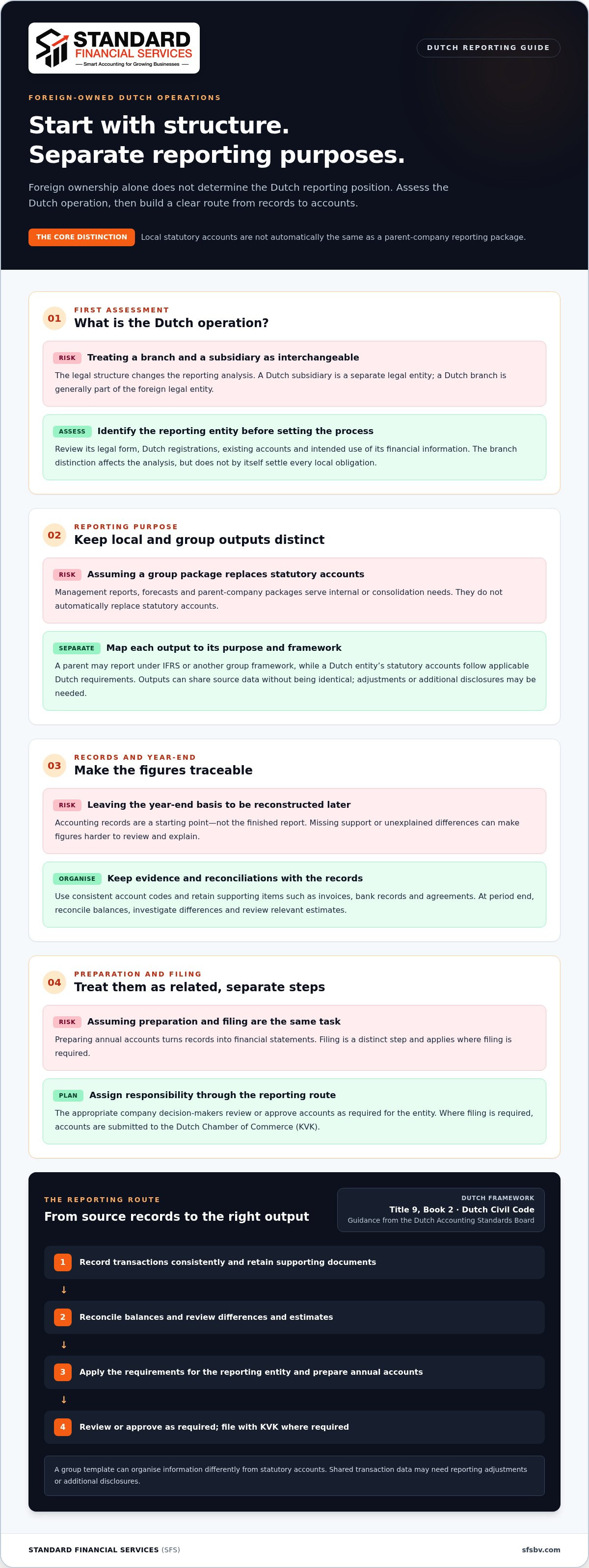
A practical Dutch GAAP preparation workflow for foreign finance teams
A repeatable process helps local reporting fit into the group’s finance calendar without leaving responsibilities unclear. For Dutch GAAP for foreign companies, start by identifying the reporting entity and applicable requirements, then organise records, reconcile balances and review the resulting accounts. Build checkpoints into the process so missing evidence or unresolved differences come to light before year-end reporting is finalised.
Prepare the entity and reporting information
Start with a compact entity file. Bring together legal-entity details, registration information, the reporting period, prior accounts and group reporting instructions. Identify the Dutch finance contact, the parent-company contact and the people responsible for preparation, review and statutory approval. Establish the entity’s reporting requirements using current authoritative guidance before setting the detailed process.
Next, agree what information to collect and how to share it. This can include transaction listings, bank and balance-sheet reconciliations, supporting documents, payroll data where relevant and group reporting inputs. Use consistent file names and storage so local and parent teams can trace figures to supporting records.
Build repeatable review and close controls
Set a recurring close calendar with an owner and reviewer for each key task. It can cover transaction cut-off, reconciliations, evidence collection, group data submission and review of the annual accounts. The sequence should reflect the entity’s reporting needs and approval workflow rather than relying on informal reminders near the reporting date.
During each close, compare local ledger balances with the relevant group reporting data. Investigate differences, document their cause and record approved adjustments with supporting evidence. For significant estimates or other accounting judgments, retain the rationale and information considered. This creates a useful record for later review and helps the team apply its process consistently across reporting periods.
- Assess: Identify the entity, reporting period and applicable requirements.
- Collect: Gather complete transaction records, supporting documents and group inputs.
- Reconcile: Match balances to evidence, compare local and group figures, and resolve differences.
- Review: Assign preparation, review and approval responsibilities, and retain documented decisions.
Clear ownership makes handovers more reliable. Assign an owner for local bookkeeping, define a contact for group reporting inputs, and follow the entity’s applicable governance process for statutory approval. Keep an open-items list for missing documents, unreconciled balances and decisions awaiting review, with responsibility assigned for each item.
For support connecting Dutch bookkeeping, tax compliance and annual-account preparation, see SFS accounting support.
How SFS supports Dutch GAAP compliance for international operations
Reliable Dutch reporting involves more than preparing accounts at year-end. Day-to-day records, tax compliance and group reporting inputs need to connect in a consistent process. Standard Financial Services (SFS) supports companies operating in the Netherlands with Dutch GAAP bookkeeping, tax compliance and annual-account preparation, connecting local finance work with wider operational needs.
Connect bookkeeping, tax compliance and annual accounts
Ongoing bookkeeping gives finance teams an organised record of transactions throughout the reporting period. SFS supports the preparation and maintenance of Dutch GAAP bookkeeping, and connects those records with tax compliance work, including VAT and corporate income tax matters, and annual-account preparation. Applicable obligations depend on the company’s circumstances, so the reporting and tax process should reflect the entity’s current requirements.
Consistency matters. Clear transaction records, supporting documents and reconciled balances give year-end preparation a dependable starting point. They also help keep information used for tax compliance connected to the underlying accounting records. This doesn’t remove the need for review or guarantee a particular result. It provides an orderly basis for preparing reports and addressing questions as they arise.
For a foreign parent, maintain local records in a way that supports Dutch reporting needs and the information requested for group reporting. SFS’s ongoing accounting support can help coordinate these recurring activities, with the different uses of local finance information in view.
Coordinate local finance with international operations
Cross-border processes often involve separate systems, reporting calendars and charts of accounts. SFS supports businesses operating in the Netherlands with local finance processes, connecting bookkeeping with annual-account preparation and tax compliance. Defined responsibilities and recurring information flows can make handovers between Dutch and international finance teams easier to manage.
Where a company’s systems need to exchange financial data across international branches, ERP integration can support a clearer flow of information between them. The approach should reflect the organisation’s systems and reporting needs, while keeping local records traceable for Dutch finance work. Consistent data exchange can reduce repeated manual handling, but it doesn’t make local and group reporting requirements interchangeable.
With more than five years of experience and more than 25 active clients, SFS supports ongoing Dutch finance processes for international operations. The focus is on connecting bookkeeping, tax compliance and annual-account preparation, while helping teams coordinate local information with parent-company reporting.
If your finance team is organising Dutch reporting or refining its local process, learn about SFS’s Dutch accounting support.
Make Dutch reporting part of your operating rhythm
Turn the reporting requirements that apply to your Dutch operation into a routine your finance team can maintain. Agree who owns local records, how information moves between the Dutch operation and the parent company, and when unresolved items are escalated. A well-defined process gives international teams a clearer basis for keeping Dutch GAAP for foreign companies aligned with wider financial planning as operations change.
You don’t need to wait until year-end to improve coordination. Reviewing how local bookkeeping, tax work and group reporting connect can reveal where responsibilities or information flows need clarification. SFS supports Dutch finance processes with accounting services shaped around your operational needs.
Discuss Dutch accounting support with SFS to plan a more orderly reporting process.
Frequently Asked Questions
Can a foreign parent company prepare the Dutch entity’s accounts?
Yes, a foreign parent can coordinate preparation, but that doesn’t settle whether separate Dutch statutory accounts are required. For example, the parent may collect figures for group consolidation while the Dutch entity maintains local records and completes any applicable statutory process. Identify the Dutch reporting entity, the intended use of each set of accounts and who is responsible for local approval. Establish the applicable duties under current Dutch rules.
Is Dutch GAAP the same as IFRS?
No. Dutch GAAP and International Financial Reporting Standards (IFRS) are separate accounting frameworks, even if they address similar topics. A group might request IFRS-based information for consolidation while a Dutch entity’s statutory reporting follows applicable local requirements. For instance, the same transaction data may need to be organised differently for each output. Assess each reporting purpose separately and establish the relevant framework before preparing accounts or group submissions.
Can a foreign company’s accounting software support Dutch GAAP reporting?
Yes, software can support the process if it captures complete transactions and provides usable records for the applicable reporting needs. Check whether the chart of accounts can be mapped to Dutch reporting lines, supporting documents remain accessible, and reports can be produced for the correct period. Software alone doesn’t establish compliance. Review the setup against the entity’s circumstances and document any manual adjustments made outside the system.
What happens if Dutch statutory reporting and group reporting use different frameworks?
The company may need distinct reporting outputs or documented adjustments so each purpose is addressed. For example, the local ledger can serve as the source for both statutory reporting and a parent-company package, while a reconciliation explains differences between their figures. Record the reason, supporting information and review status for each adjustment. Don’t apply a standard adjustment formula without assessing the facts, since appropriate accounting treatment depends on the transaction and applicable guidance.
Does Dutch GAAP determine a company’s Dutch corporate income tax calculation?
No. Financial reporting and corporate income tax compliance are connected through accounting information, but the financial statements aren’t the tax return. Records may support preparation of a tax calculation, while applicable tax rules determine how taxable results are established. Keep a clear reconciliation between accounting figures and tax reporting information, and retain explanations for adjustments. This helps finance teams distinguish financial reporting decisions from tax positions that need separate assessment.
Can a Dutch branch and a Dutch subsidiary have the same reporting obligations?
Not necessarily. A subsidiary is a separate legal entity, while a branch is part of a foreign company, and that structural difference can affect the reporting analysis. For example, records for a branch may need to fit the foreign entity’s accounts as well as any applicable Dutch requirements. Before assigning responsibilities or configuring reporting systems, assess the legal structure, activities and current Dutch rules for the specific operation.
