
Dutch GAAP bookkeeping services can do more than keep a ledger in order. When day-to-day records connect with tax filings, payroll, annual accounts, and your wider finance team, they create a clearer basis for managing a Netherlands operation. When these tasks sit apart, missing documents or inconsistent figures can make reporting harder to review.
Local bookkeeping and reporting can raise practical questions, especially when your Netherlands operations also rely on international processes. A consistent approach to records helps teams manage recurring responsibilities and keep financial information aligned across the business.
This guide explains what ongoing Dutch bookkeeping support can cover and how it connects with VAT returns, corporate income tax, payroll, annual-accounts preparation, and ERP workflows. You’ll also find practical steps for organizing records and coordinating Dutch financial administration with wider business operations.
Key Takeaways
- Dutch GAAP bookkeeping services can connect recurring records with VAT returns, corporate income tax filing, and annual-accounts preparation.
- A consistent process for capturing transactions, organizing documents, and reviewing balances helps prepare financial information for year-end work.
- Agreeing on reporting periods and account mappings can make it easier to coordinate Dutch records with parent-company reporting.
- Clear responsibilities, system access, and document handoffs help establish a dependable monthly bookkeeping workflow.
- Bookkeeping can work alongside payroll management, ERP integration, and financial consulting to support Netherlands operations.
What Dutch GAAP bookkeeping services cover for a Netherlands business
Dutch GAAP bookkeeping is the ongoing recording and organization of a business’s financial transactions in line with the Dutch reporting requirements that apply to it. Year-end reporting uses those records to prepare annual accounts. The applicable reporting basis depends on the entity and its circumstances. The practical goal is to maintain clear, traceable records throughout the year, rather than reconstructing the ledger at year end.
For a Netherlands business, Dutch GAAP bookkeeping services can bring recurring administration and reporting tasks into a coordinated process. Standard Financial Services supports businesses with Dutch GAAP bookkeeping, VAT return submissions, corporate income tax (CIT) filing, and annual-accounts preparation. These tasks are connected but distinct: ongoing records provide information used in tax work and financial reporting.
What does ongoing bookkeeping support usually include?
Ongoing bookkeeping records sales, supplier invoices, expenses, and bank activity as the business operates. Transactions are assigned to suitable accounts, and supporting documents are organized so balances can be checked against source records and bank information. Regular checks help identify missing documents or inconsistencies before they affect tax or year-end work.
Reconciled, up-to-date records can support VAT submissions and CIT filing while giving management a clearer view of income, costs, and outstanding amounts. A practical monthly workflow commonly includes:
- Collecting and recording transaction documents.
- Matching bank activity to recorded transactions.
- Reviewing balances and following up on discrepancies.
- Keeping organized information available for tax submissions and annual-accounts preparation.
Bookkeeping and annual-accounts preparation are not statutory audits. Bookkeeping maintains and organizes financial information; annual-accounts preparation uses that information for year-end reporting. An audit is a separate independent examination, so it should not be confused with routine bookkeeping or accounts preparation.
How Dutch GAAP relates to other reporting frameworks
Dutch statutory reporting and international group reporting serve different purposes. Statutory accounts are prepared for the applicable Dutch reporting context, while a parent company may need figures presented in its management or consolidation format. The same underlying financial data may therefore need to be organized for more than one reporting purpose.
The Raad voor de Jaarverslaggeving (Council for Annual Reporting) issues guidance through the Standards for Annual Reporting. Applicable requirements depend on factors such as an entity’s reporting category. Dutch GAAP and IFRS are distinct frameworks, not interchangeable labels. Businesses with international reporting needs can reduce confusion by agreeing how account categories, reporting periods, and supporting records will be aligned, while keeping Dutch statutory requirements clear.
How Dutch GAAP bookkeeping connects monthly records to annual accounts
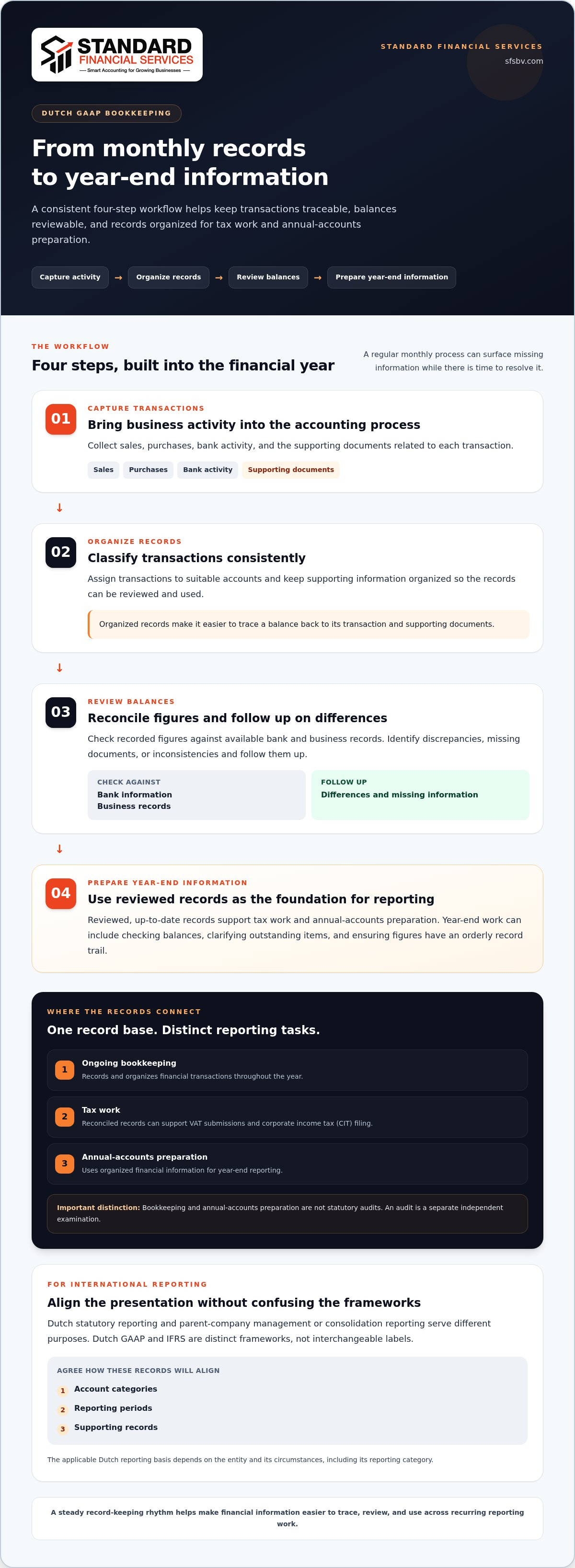
Complete, well-organized bookkeeping records give year-end reporting a reliable foundation. They make transactions traceable, balances reviewable, and supporting information available for tax work and annual-accounts preparation. This connection is built throughout the year, not created in a last-minute year-end exercise. A consistent monthly process helps surface missing information while there is still time to resolve it.
A clear workflow moves from day-to-day activity toward year-end information in four steps:
- Capture transactions: Bring sales, purchases, bank activity, and related supporting documents into the accounting process.
- Organize records: Classify transactions consistently so the information can be reviewed and used.
- Review balances: Reconcile recorded figures with available bank and business records, then follow up on differences.
- Prepare year-end information: Use the reviewed records to support tax work and annual-accounts preparation.
From business transactions to organized accounting records
Invoices and bank activity tell part of the story; supporting documents explain what each transaction relates to. Once transactions are classified and records reconciled, the figures become more useful than a simple list of incoming and outgoing payments. For example, the business can distinguish operating costs from sales activity and check whether recorded amounts align with the supporting information.
This structure also helps teams work from a shared financial picture. If a balance needs clarification, the related transaction and its supporting documents are easier to trace. That can simplify VAT preparation and help identify items that need attention before tax submissions or year-end reporting. Dutch GAAP bookkeeping services are most effective when this record-keeping rhythm continues throughout the financial year.
From bookkeeping records to annual-accounts preparation
At year end, reviewed records provide the starting point for checking balances and assembling information for annual accounts. Preparation can involve clarifying outstanding items and ensuring figures are supported by an orderly record trail. Filing requirements and deadlines depend on the entity and current rules.
Where the applicable workflow involves the Dutch Chamber of Commerce (KVK), annual-accounts preparation and filing are separate steps. Preparation organizes financial information for reporting; filing submits the relevant accounts through the applicable process. Neither step is the same as independent audit or assurance work.
For cross-border businesses, a clear close process can also help local and international finance teams align on figures and reporting periods. Deloitte’s External Reporting Manual (NL GAAP) provides guidance on Dutch legal provisions and accounting standards, with practical examples and discussion of differences from IFRS. The frameworks should not be treated as interchangeable.
To connect recurring records with tax and year-end reporting, explore coordinated bookkeeping and tax support for Netherlands operations.
How Dutch GAAP bookkeeping services support international reporting
A Netherlands entity may need financial information for two audiences: local reporting and tax processes, and the management or consolidation needs of an international parent company. The figures may originate from the same transactions, but each audience can require a different presentation. Dutch GAAP bookkeeping services help keep local records structured and make relevant information easier to align with group reporting.
Dutch statutory records and parent-company reporting
Local statutory reporting serves the Dutch entity’s applicable requirements. Parent-company reports may instead group results by global business line, cost centre, or another internal structure. The two views should be coordinated, not confused: IFRS or a parent’s reporting format does not automatically replace Dutch statutory requirements.
A shared mapping approach can connect local account codes to group categories. For example, if Dutch accounts record several types of operating costs separately, the parent may require them to roll up into one management-reporting category. Agreed definitions, consistent mappings, and a documented approach to adjustments help finance teams interpret figures on the same basis.
| Reporting view | What it serves | Coordination focus |
|---|---|---|
| Local reporting | Dutch statutory accounts and local tax-related processes | Applicable Dutch requirements, local records, and supporting detail |
| Group reporting | Parent-company management and consolidation | Group account mappings, reporting definitions, and agreed periods |
The table describes different reporting purposes, not separate versions of the underlying business activity. A useful process preserves local detail and makes the group view traceable back to it. Finance teams can then investigate a consolidated figure without losing sight of the Dutch records behind it.
Coordinating finance systems across borders
ERP integration can support the exchange of financial data between a Netherlands operation and international teams. The setup should reflect the systems and workflow involved. Even without direct system-to-system exchange, teams can define a consistent process for sharing and reviewing finance information.
Before setting the process, agree on practical responsibilities:
- Ownership: Identify who maintains Dutch records, approves adjustments, and prepares group submissions.
- Data format: Set out how account codes, currencies, entity identifiers, and supporting details will be presented.
- Reporting cadence: Align period cut-offs and submission dates so local and group teams work from comparable information.
Aligned account mappings, reliable source records, clear data ownership, and agreed reporting periods help international finance teams compare results, trace consolidation figures, and coordinate local reporting with parent-company decisions. ERP integration and financial consulting can support this coordination by clarifying how information moves between the Dutch operation and the wider finance function.
How to prepare for a dependable Dutch bookkeeping workflow
A predictable bookkeeping process starts with clear information flow. Before recurring work begins, establish how the Netherlands entity operates, where its financial records sit, who supplies key documents, and which reports the business needs. Use this overview to agree a workable handoff that reflects the company’s setup.
Set up the finance handoff
Start with the essentials: the entity’s business activities, accounting period, bank accounts, accounting system, and existing reporting structure. Make sure the people responsible for the records understand how information will be shared and where questions should go. This gives the finance workflow a practical starting point without requiring every business to follow the same setup.
Next, assign ownership for the information that feeds into the accounts. Depending on the company, this may include:
- Source documents: who gathers and provides invoices, receipts, and other relevant records.
- Approvals: who reviews or approves transactions and financial information.
- Payroll inputs: who supplies the information needed for payroll processing.
- Management questions: who can explain unusual transactions or clarify business decisions reflected in the records.
Clear ownership reduces uncertainty about missing information. It also keeps responsibilities visible when internal staff, a Dutch finance function, and an international team all contribute.
Align reporting expectations and responsibilities
Agree how often information will be exchanged, which communication channels teams will use, and how recurring tasks are divided. For example, define who provides source records, who reviews open questions, and who prepares information for management reporting. If a parent company has group-reporting definitions, account mappings, or specific period cut-offs, share them early so local and group processes can be coordinated.
System-to-system coordination may be useful when Dutch records need to feed into wider finance systems. ERP integration can support that work, with the approach shaped around the systems and reporting needs involved. Set expectations for data formats, access, ownership, and the handling of adjustments before relying on information transfers. These decisions help teams understand which figures are local records and how they relate to group reports.
Keep the arrangement practical. A company with a straightforward local setup may need a different handoff from a business coordinating several entities across borders. Dutch GAAP bookkeeping services can be organized around the entity’s accounting context and reporting responsibilities, with clear routes for documents, approvals, and queries.
For a structured finance handoff, discuss Dutch bookkeeping support with Standard Financial Services.
SFS Dutch GAAP bookkeeping services for ongoing Netherlands operations
For a Netherlands operation, finance support works best when recurring records, tax administration, and year-end reporting follow a connected process. Standard Financial Services supports businesses across the Netherlands with Dutch GAAP bookkeeping, VAT return submissions, corporate income tax filing, and annual-accounts preparation. This scope helps organize local financial administration and provides a clear basis for related reporting work.
A coordinated back-office partner for Dutch operations
Bookkeeping is the operational foundation: transactions are recorded and maintained so that tax and reporting tasks can draw on organized information. SFS connects ongoing bookkeeping with VAT returns, corporate income tax filing, and annual-accounts preparation, helping businesses coordinate work that can otherwise sit across separate processes. Liaison with the Dutch Chamber of Commerce can also form part of the relevant annual-accounts workflow.
That connection is useful for international businesses establishing or managing operations in the Netherlands. Local records need to serve the Dutch entity, while finance teams abroad may also need consistent information for group management and consolidation. Clear reporting expectations and well-defined handoffs help both sides work with financial data in a coordinated way, without treating parent-company reporting as a substitute for local requirements.
Related support can connect the bookkeeping workflow with other operational needs:
- Payroll management can align payroll administration with the wider finance process.
- ERP integration can support coordination between accounting systems and broader business systems, depending on the workflow.
- Financial consulting can help businesses assess finance processes and reporting needs as their operations develop.
These areas can be coordinated around a company’s context rather than treated as unrelated administrative tasks. The aim is a workable structure in which responsibilities, records, and reporting information fit the business’s Netherlands operations and international requirements.
What the next step looks like
A useful starting point is a concise overview of your Netherlands operations, accounting period, current finance workflow, and reporting requirements. Include how local records are maintained, which team members provide information or approvals, and whether a parent company has group-reporting expectations. This gives the discussion a practical focus and helps identify where bookkeeping, tax work, payroll, or systems coordination need to connect.
Standard Financial Services tailors bookkeeping and related support to the business context, including handoffs between local and international finance teams. The scope can be shaped around current processes and operational priorities, rather than assuming every company needs the same setup.
To discuss a bookkeeping workflow for your Netherlands operations, explore SFS bookkeeping and finance support.
Build a finance workflow that can grow with your business
A reliable finance process should fit the way your Netherlands operation works now and remain clear as responsibilities, systems, or group reporting needs change. Dutch GAAP bookkeeping services are most useful when handoffs are understood: who provides information, who reviews it, and how local records support wider business decisions. Reviewing those responsibilities periodically can help keep the workflow practical as the business develops.
Standard Financial Services brings bookkeeping together with related tax, payroll, ERP integration, and financial consulting support. SFS has over five years of experience and supports more than 25 active clients with financial services.
Start by identifying the finance tasks that need clearer ownership or coordination. A focused discussion can help shape a workflow around your entity, existing systems, and reporting priorities, rather than forcing your operations into a generic process. Discuss Dutch GAAP bookkeeping support with SFS and take a considered next step toward a more dependable finance routine.
Frequently Asked Questions
What is Dutch GAAP bookkeeping?
Dutch GAAP bookkeeping is the maintenance of business records in line with the Dutch accounting and reporting requirements that apply to a company. Routine bookkeeping records and organizes financial activity; year-end accounts preparation uses those records to create financial statements. The relevant process can differ according to the company’s circumstances and reporting obligations. For entity-specific statutory details, consult current guidance from the Dutch Chamber of Commerce (KVK) and other relevant Dutch authorities.
Is Dutch GAAP the same as IFRS?
No. Dutch GAAP and IFRS are distinct reporting frameworks, even if some principles or reported outcomes may be similar. The framework relevant to a business depends on its legal and statutory context, as well as any separate group-reporting needs. A parent company’s preferred reporting format does not automatically determine the Dutch entity’s statutory basis. Confirm the applicable framework against current authoritative Dutch guidance and the company’s circumstances before setting reporting procedures.
Can a foreign company use Dutch GAAP bookkeeping services?
Yes. A foreign business operating in the Netherlands can use Dutch GAAP bookkeeping services to support local financial administration, while its parent company may require separate group reports. For example, a Dutch operation can maintain local records while providing management figures in the parent’s preferred categories. Coordinating those outputs requires clear definitions and finance contacts. The company’s structure and activities affect its Dutch obligations, so requirements should not be assumed to be identical across foreign businesses.
How do Dutch annual accounts reach the Chamber of Commerce?
Annual accounts are prepared using the company’s accounting information and, where filing is required, submitted through the applicable Dutch filing process to the Chamber of Commerce (KVK). The required format, submission method, and timing depend on the entity and current rules. A company should not rely on a universal deadline or process. Check current KVK guidance for the filing requirements that apply to its legal form and circumstances.
Can Dutch bookkeeping records also support international group reporting?
Yes. Dutch bookkeeping records can inform both local financial administration and internal group reporting when teams agree how account categories and reporting periods relate. For instance, a parent company may request a consolidated view that groups several local expense accounts into one category. A documented mapping helps explain that presentation and trace it back to local records. Data exchange is not automatically compatible across finance systems; ERP integration depends on the company’s existing setup.
Does Dutch GAAP bookkeeping include statutory audit services?
No. Bookkeeping and statutory audit are distinct activities. Bookkeeping maintains and organizes financial records, while an audit is a separate assurance engagement with its own scope and requirements. Standard Financial Services provides bookkeeping and related tax-compliance support, not statutory audit services. If a company has a separate audit obligation, bookkeeping alone does not meet it. The business should establish its reporting and assurance requirements based on its circumstances and current authoritative guidance.
Can bookkeeping services coordinate payroll and tax administration?
Yes. Businesses can coordinate bookkeeping with payroll management and tax compliance so financial information and responsibilities stay aligned. For example, payroll inputs can be assigned to a clear internal contact, while relevant accounting information supports the wider finance process. Standard Financial Services offers bookkeeping, payroll management, and tax-compliance support. The workflow depends on the company’s operations, reporting needs, and division of responsibilities, rather than following one fixed process for every business.